
Nutrition Guide for Growing Children
25 Apr, 2026
A child who eats poorly does not always look unwell. They go to school; they play; they seem fine. The effects of inadequate nutrition in children are rarely dramatic in the short term. They show up slowly in a concentration that fades by mid-morning, in a body that catches every infection going around, and in growth that is quietly below where it should be. By the time parents connect those dots, the pattern has been in place for months.
Nutrition is not a crisis topic. It is a daily one. And the earlier families in Jaipur build the right habits, the less catching up their children need to do later.
Signs a Child's Diet Is Not Meeting Their Needs
Children do not report nutritional deficiencies. They just behave differently. Parents who know what to look for catch these signs before they become clinical problems.
Watch for:
- Energy that drops sharply after meals rather than sustaining through the day
- Illness that comes around more than four or five times a year is a sign immunity is genuinely under-resourced
- Difficulty holding attention at school or during tasks that require sustained focus
- Physical growth that consistently tracks below the expected range for the child's age
- Pale skin, hair that breaks easily, or nails that are brittle are frequent indicators of iron or zinc deficiency
- Mood instability and emotional crashes that seem disproportionate to the situation
These signs, when they appear together and persist over weeks, point toward diet before anything else. Healthy food for children in India addresses these patterns where they actually originate rather than managing each symptom separately.
Why the Diet Falls Short in Most Families
The causes behind poor childhood nutrition in India are rarely about intent. They are about circumstance, habit, and the food environment children grow up in.
Processed and packaged foods designed for children are engineered to be immediately appealing high in sugar, low in fibre, and stripped of the micronutrients growing bodies require. They are also fast to prepare, which makes them the default in households where time is limited. Following sound child nutrition tips in India, pediatricians recommend starts with recognising that convenience foods fill a caloric gap while consistently missing the nutritional one.
Picky eating compounds the problem. A child who refuses vegetables at age three is responding normally to unfamiliar textures and tastes. The mistake is accepting that refusal as permanent. Children who are repeatedly exposed to varied foods even when they initially reject them eventually broaden their acceptance. Children whose refusal is accommodated indefinitely do not.
Irregular meal timing is the third common cause. Children who eat at inconsistent intervals experience blood sugar instability that directly affects energy, mood, and concentration. Structured mealtimes are not rigid; they are physiologically necessary.
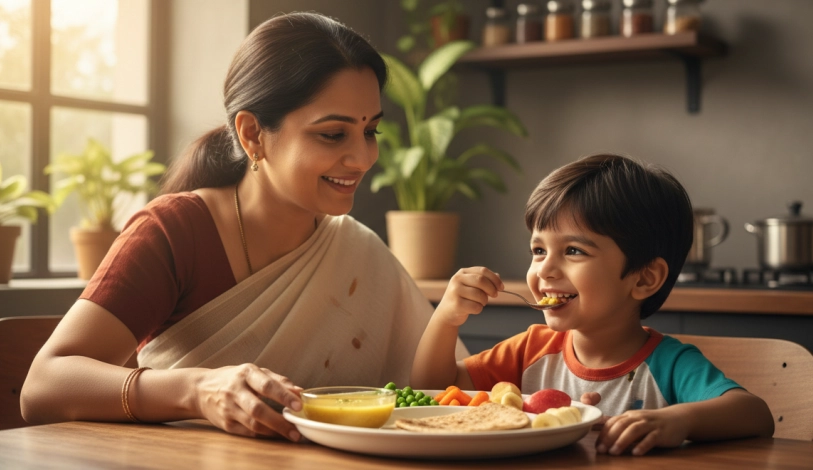
What a Practical Balanced Diet Actually Looks Like
A kids diet plan in Jaipur does not require elaborate preparation or expensive ingredients. It requires variety and consistency across the following:
Protein at every main meal: dal, eggs, curd, paneer, chicken, fish. Protein supports muscle development, immune function, and sustained energy. A breakfast without protein is a breakfast that will not carry a child through the morning.
Complex carbohydrates: whole grain roti, oats, millet, and brown rice. These release energy gradually rather than spiking blood sugar and crashing it. The difference between a child who concentrates well and one who fades by mid-morning is frequently what they ate two hours earlier.
Vegetables and fruit daily: the most consistently under-consumed category in Indian children's diets. Fresh seasonal produce provides vitamins, minerals, and fibre that no supplement fully replaces. Introduce variety early and keep introducing it rejection at one stage does not predict rejection at the next.
Dairy: milk, curd, and paneer provide calcium essential during the years when bone density is forming most rapidly. Deficits in childhood calcium intake carry consequences into adulthood that are difficult to reverse.
Healthy fats: ghee, nuts, seeds. Brain development in children depends on adequate fat intake. The instinct to reduce fat in children's diets is usually misapplied; the source of fat matters more than the quantity.
Water throughout the day: not juice, not packaged drinks. Dehydration in children produces fatigue, reduced concentration, and irritability that parents frequently misread as behavioural.
When a Specialist's Input Is Needed
General dietary principles apply broadly. But a child who has been underweight for a sustained period, a child with a confirmed micronutrient deficiency, or a child with a medical condition affecting absorption needs individual assessment not a general framework.
A pediatric nutritionist in Jaipur builds a plan around the specific child. Their age, weight, health history, food preferences, and the family's actual cooking practices all shape what will realistically work. Advice that does not account for those factors does not get followed.
At Jaipur, nutritional assessment is part of routine pediatric care. A pediatric nutritionist in Jaipur is accessible without waiting for a deficiency to become severe before the conversation starts.
Habits That Make the Difference Day to Day
The best diet for kids in Jaipur is the one the family actually maintains not the theoretically ideal plan that collapses under the pressure of a normal week.
Consistent habits that work:
- Eat together as a family where possible children eat more varied food in social mealtimes
- Keep fruit visible and within reach children eat what is accessible without effort
- Involve children in simple food preparation a child who helped make the food tries it more willingly
- Buy fewer packaged snacks children do not miss what is not in the house
- Introduce new foods alongside familiar ones rather than replacing them
- Avoid using food as reward or punishment this creates lasting unhealthy associations with eating
A kids diet plan in Jaipur built on these habits produces results that dramatic short-term changes never sustain.
The Foundation Is Built Now
The years between birth and adolescence are when nutrition has its greatest influence on how a child develops physically, cognitively, and immunologically. Following the right child nutrition tips India specialists consistently recommend during this window is not optional preparation for later health. It is health itself built day by day through what a child eats and what they consistently do not.
The best diet for kids in Jaipur is not perfect. It is regular, varied, and supported by a medical team that guides families practically rather than ideally.