
Flat Feet in Children: Is Treatment Really Necessary?
24 Jul, 2026
It's easy to notice when a child stands barefoot, and the whole foot presses flat to the floor with no visible arch. A relative may have already commented on it, leaving a parent wondering whether a doctor's appointment is needed right away. The reassuring answer for most families is that flat feet in children are very common and don't always require treatment. Arches often develop naturally as children grow. But in some children, flat feet do cause pain, fatigue, or postural problems that genuinely benefit from specialist attention.
What Flat Feet Actually Are
Flat feet, clinically called pes planus, refer to low or absent arches that cause the sole to make near-complete contact with the ground. Almost all infants and toddlers appear flat-footed because the arch hides under a natural fat pad in early childhood. By ages six to eight, most children develop a visible arch. When that change doesn't happen, the condition is referred to as persistent flat feet.
Three types are worth knowing. Flexible flat feet are the most common an arch appears when the child stands on tiptoe, and the condition usually resolves naturally with age. Rigid flat feet remain flat even on tiptoes and need proper evaluation. Acquired flat feet develop later due to injury or muscle weakness rather than being present from birth.
When to See a Pediatric Orthopaedic Doctor in Jaipur
Most children with flat feet can walk and run just fine. Here are some genuine reasons to schedule an appointment with a pediatric orthopedic doctor in Jaipur, rather than adopting a watch-and-wait approach.
- Pain or ache in your feet, ankles or knees, especially after you’ve been active
- Abnormal wear patterns on shoes or difficulty finding shoes that fit well
- Rapid feeling of leg tiredness with walking or sport
- Clumsiness or tripping that appears to occur more often than would be expected for the child's age
- asymmetry is always worth checking. One foot quite a lot flatter than the other
- Limited ankle movement due to tight Achilles tendon limiting comfortable range of motion
Diagnosis and Treatment Options
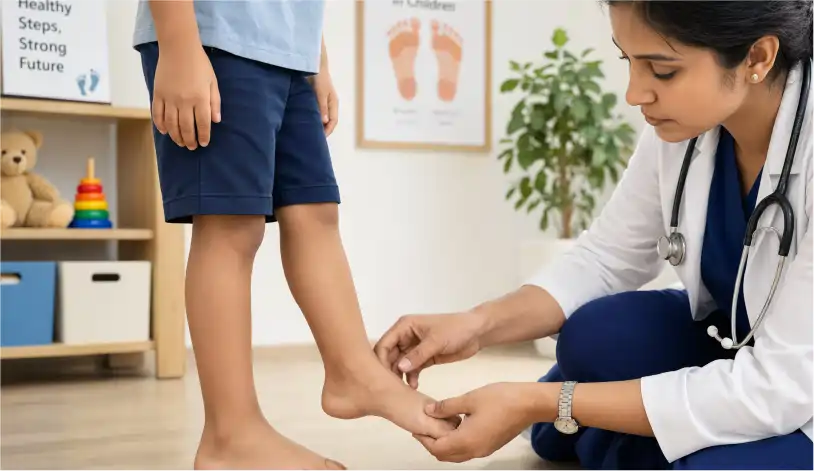
A child bone specialist in Jaipur will examine the foot, observe the child walking, and may request an X-ray to assess bone alignment. Treatment is not always necessary for painless, flexible flat feet, watchful observation is usually sufficient. When symptoms are present or there are warrants for intervention, the approach is conservative first.
- Supportive footwear with good arch support built into the structure
- Custom orthotic insoles fitted after a proper assessment rather than bought generically
- Physiotherapy to stretch the Achilles tendon and strengthen the arch-supporting muscles
- Activity modification during painful periods while treatment takes effect
- Surgery, considered only in rare cases of rigid or severely symptomatic flat feet that haven't responded to conservative care over time
Prevention Tips for Parents
These habits actively strengthen foot muscles and reduce the risk of symptomatic flat feet developing as children grow.
- Encourage barefoot walking on grass and sand, which builds the small muscles of the foot naturally
- Choose well-fitted shoes and avoid flat, unsupportive footwear such as flip-flops for long periods
- Keep up regular physical activity, since sedentary habits weaken foot-supporting muscles over time
- Monitor shoe wear patterns unusual wear on the inner edge of the sole can signal a gait issue early
Conclusion
Most children with flat feet need nothing more than reassurance and sensible footwear choices. But for the children who do have symptoms, getting a proper assessment early means catching any structural issue before it causes longer-term problems with posture, gait, or joint health. The difference between a child who struggles with foot pain through school and one who doesn't often come down to one early conversation with the right specialist. Book a consultation with a child bone specialist in Jaipur at Neo Clinic today.