
Advanced PICU Care in Jaipur: What Parents Should Know During a Critical Illness
22 Sep, 2026
Overview
Having a child admitted to intensive care is a uniquely frightening experience, made harder by unfamiliar equipment, medical terminology, and a level of uncertainty most parents have never had to navigate before. Nothing about a normal week of parenting prepares anyone for a room full of monitors and a team of strangers making split-second decisions about your child. Understanding what a PICU hospital in Jaipur actually does, and what to expect during a stay doesn't make the situation less serious, but it does make it considerably less disorienting.
What Is a PICU and Who Needs It?
A pediatric ICU in Jaipur is built specifically to manage critically ill children who need continuous, intensive monitoring and support beyond what a general pediatric ward can provide. This includes children with severe respiratory failure, those recovering from major surgery, cases of severe infection or sepsis, and children requiring life support following trauma or a serious medical event.
Pediatric critical care in Jaipur at this level involves a team trained specifically in managing children's physiology under extreme stress, which behaves quite differently from how adults respond to critical illness a child can compensate for a worsening condition right up until they suddenly can't, which is part of why this kind of close, specialised watching matters so much.
What Conditions Typically Require PICU Admission?
- Severe respiratory distress requiring ventilator support
- Septic shock or severe systemic infection
- Major trauma, including head injury or significant blood loss
- Post-operative monitoring following complex or high-risk surgery
- Severe diabetic ketoacidosis or other acute metabolic emergencies
- Status epilepticus, a seizure that doesn't stop on its own
What Does PICU Care Actually Involve?
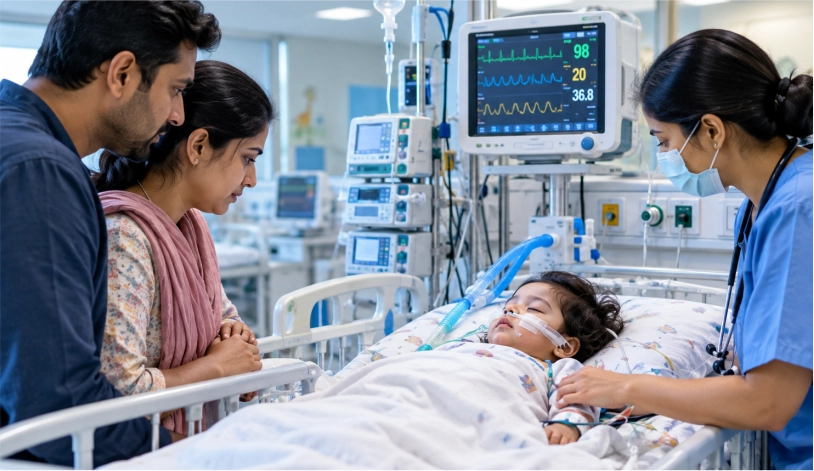
Child ICUs in Jaipur settings are equipped with continuous monitoring of heart rate, oxygen levels, and other vital signs, along with the capability to provide mechanical ventilation, medications to support blood pressure and organ function, and rapid intervention if a child's condition changes suddenly.
A multidisciplinary team, typically including intensivists, pediatric specialists relevant to the underlying condition, and specially trained nursing staff, reviews and adjusts the treatment plan continuously rather than at fixed intervals, since critically ill children can change status quickly enough that a once-daily review isn't sufficient. It's not unusual for the plan on a Tuesday morning to look different by Tuesday evening, and that's a sign the team is responding closely, not a sign that something's going wrong.
How Should Parents Prepare for a PICU Stay?
The unfamiliarity of a PICU environment, the equipment, the alarms, and the pace of activity tends to be as stressful for parents as the illness itself. Most units encourage parental presence at the bedside once the child is stabilised, and asking the care team direct questions about what each piece of equipment is doing and what the plan looks like day to day can help make the environment feel less alien over time. It's reasonable to ask for updates in plain language rather than clinical shorthand, and most PICU teams are used to and prepared for exactly this kind of conversation. There's no such thing as a question too basic to ask when it's your child in that bed.
Who Should Know Their Nearest PICU Facility?
- Families managing a child with a chronic condition that carries risk of acute deterioration, such as severe asthma or a seizure disorder
- Parents of children with congenital conditions that may require critical care support at some point
- Anyone whose child has undergone or is scheduled for major surgery
- Families in Jaipur and across Rajasthan seeking a facility equipped for the most serious pediatric emergencies
- Neo Clinic's Pediatric Intensive Care Unit provides advanced critical care for children requiring life-saving treatment, coordinated closely with the hospital's broader pediatric specialities so a child's underlying condition is managed alongside their acute critical care needs.
Conclusion
A PICU admission is frightening by nature, but understanding what the unit is actually doing and why helps parents feel less powerless during it. Neo Clinic's PICU in Jaipur provides intensive, specialist-coordinated care in the situations that matter most, and that coordination continues after discharge. The same specialists typically stay on for whatever follow-up care the underlying condition needs, so families aren't left to figure out the next steps alone once the acute crisis has passed.