
Speech Delay vs Late Talking: When Is It Time to Seek Professional Help?
19 Aug, 2026
Every child develops language at their own pace, which is exactly why so many parents feel uncertain when their toddler seems to talk less than cousins or classmates of the same age. The question that comes up most often in our clinic is simple: Is my child's speech delay normal?
Understanding the real difference between typical late talking and a genuine Speech Delay in Children can save families months of unnecessary worry or, in other cases, help them seek support before a gap becomes harder to close.
Late Talking vs Speech Delay: What's the Difference?
A late talker is typically a child who understands language well, can follow directions and can communicate with gestures and expressions, but who says fewer words than expected for his/her age. Many late talkers catch up on their own by age 3, especially if they are meeting other developmental milestones.
A real speech delay, on the other hand, is often accompanied by other signs: a limited understanding of instructions, little interest in communicating at all or a gap that is getting wider rather than narrowing with time. This difference is important, because the right answer to each situation is very different.
Typical Milestones Parents Can Track
By around 12 months, most children say a few simple words like "mama" or "papa". By 18 months, a vocabulary of ten to twenty words is common, and by age two, short two-word phrases such as "more milk" usually appear. By age three, children typically form short sentences that are understandable to family members most of the time.
These are general guidelines rather than strict rules, since normal variation exists, but a child falling significantly behind several of these markers together is a stronger signal than being behind on just one.
Signs That Warrant a Closer Look
A few signs deserve prompt attention rather than a wait-and-watch approach, and are worth discussing at a Child Development Center Jaipur families can access without long waiting periods:
- Limited eye contact or little interest in pointing and showing objects to caregivers
- Not responding to their name consistently
- Loss of previously learned words
- Difficulty following simple two-step instructions
- Very limited babbling as an infant, or frustration tied to communication difficulty
Why Early Intervention Matters
Research consistently shows that Early Intervention for Children with genuine speech and language delays leads to significantly better outcomes than a delayed approach. The brain's language centres are most adaptable in the first few years of life, making early therapy far more effective than starting the same support later.
Even when a delay turns out to be mild, an evaluation gives parents clarity and, if needed, simple home strategies that support faster progress, such as narrating daily activities and reducing passive screen time in favour of interactive play.
What is Involved in Speech Therapy?
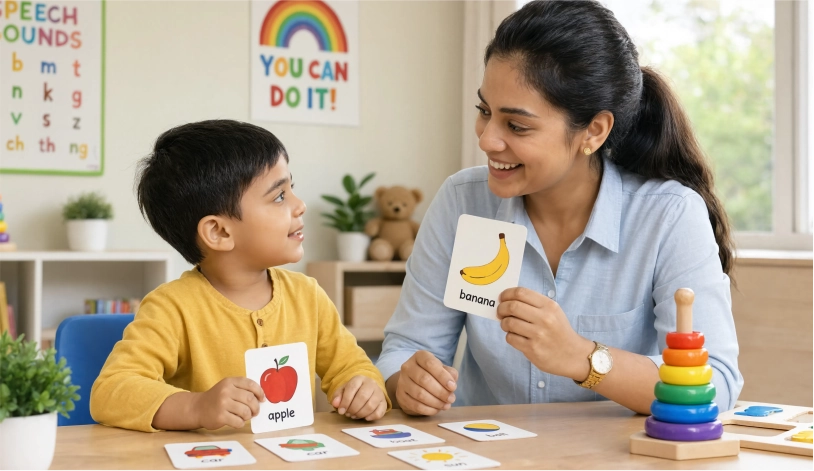
Child Speech Therapy Jaipur programmes usually begin with a thorough evaluation of a child’s understanding, expression and social communication skills, followed by planned play-based sessions designed to address the specific deficit noted. Normally, the parents are directly involved and learn techniques that they can continue with at home in between sessions.
Children develop at different rates, but many toddlers show great progress within a few months of consistent, age-appropriate therapy, especially if started before age three.
Supporting Speech Development at Home
Alongside professional therapy, small daily habits at home make a meaningful difference. Reading aloud together, narrating everyday activities such as cooking or getting dressed, and giving a child time to respond without immediately finishing their sentences all encourage natural language practice throughout the day.
Limiting background television, which can turn into unengaging noise rather than genuine language input, and instead choosing face-to-face interaction, singing simple rhymes, and responding warmly to every attempt a child makes to communicate, builds confidence alongside vocabulary. Consistency across parents, grandparents and caregivers in using these small techniques tends to produce far better results than occasional, isolated efforts. Celebrating small progress, rather than correcting every mispronounced word, also keeps children motivated to keep trying rather than growing hesitant about speaking at all.
Conclusion
Not every quiet toddler has a problem, but a widening communication gap is never something to simply wait out. A timely evaluation offers reassurance or a clear path forward, and both are valuable for parents. At Neo Clinic, our child development team in Jaipur works closely with families to accurately assess speech milestones and provide early, effective intervention when required.