
Febrile Seizures in Children: First Aid and Emergency Warning Signs
28 Oct, 2026
Parents who have witnessed a febrile seizure often describe it as the most frightening minute of their lives. A child with a fever suddenly goes stiff, the eyes roll back, and the arms and legs begin to jerk. Many parents are convinced something catastrophic is happening. In most cases, it is not. Febrile seizures in children are fits triggered by fever, and they affect roughly 2 to 5 in every 100 children between six months and five years of age. The vast majority are brief, stop on their own and cause no lasting harm. Knowing what to do in those moments and when to seek help turns panic into action. Families looking for the best pediatric neurologist for febrile seizures in Jaipur often begin searching right after that first episode.
What Is a Febrile Seizure?
A febrile seizure is a convulsion that happens with a fever, usually 38°C (100.4°F) or higher, in a child who does not have a brain infection or a known seizure disorder. It often occurs on the first day of illness, sometimes before parents even realise the child has a temperature. Common triggers include viral infections, ear infections, roseola and, less often, fever after vaccination.
Doctors divide febrile seizures in children into two types:
- Simple febrile seizures: the most common type. They involve the whole body, last less than 15 minutes (usually only a few), and happen once in 24 hours.
- Complex febrile seizures: last longer than 15 minutes, affect only one side or part of the body, or happen more than once within 24 hours.
A family history of febrile seizures increases the likelihood. About one in three children who have one febrile seizure will have another during a later illness, most often within the next year or two.
What First Aid Should Parents Give During a Febrile Seizure?
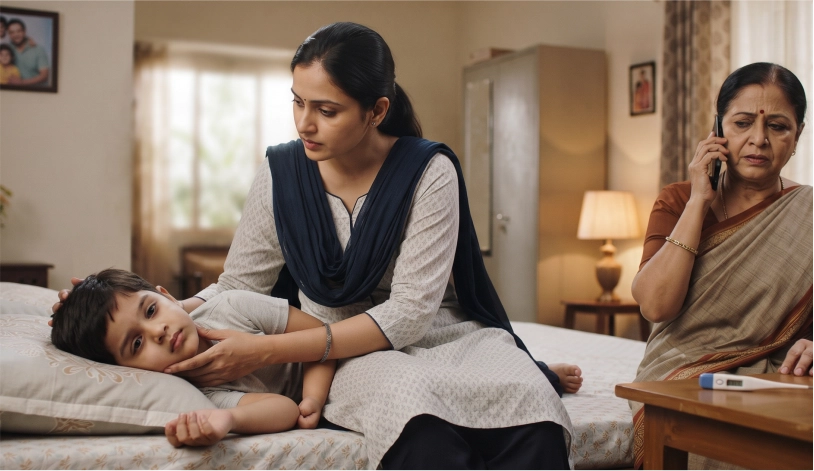
What first aid should parents give during a febrile seizure? The goal is to keep your child safe until the seizure passes. Knowing what to do during a fever seizure in a child makes those minutes far less frightening.
Do
- Stay calm and note the time the seizure starts
- Place your child on a soft, flat surface such as the floor or a bed, away from hard or sharp objects
- Turn them onto their side (the recovery position) so saliva or vomit can drain from the mouth
- Loosen tight clothing around the neck
- Stay with your child and watch their breathing and colour
- If possible, have someone record a short video, which can help the doctor later
Don't
- Put anything in their mouth, including a spoon, finger or cloth. A child cannot swallow their tongue.
- Try to hold them down or stop the movements
- Give food, water or medicine by mouth during the seizure
- Put the child in a cold bath or splash water on them
After the jerking stops, children are usually drowsy or confused for a while. Keep them on their side and let them rest. Once they are fully awake, fever medicine can be given for comfort if your doctor advises.
Is a Fever Seizure Dangerous and When Should We Visit a Hospital?
Is a fever seizure dangerous and when should we visit a hospital? Simple febrile seizures are not known to cause brain damage, intellectual problems or learning difficulties. Even so, every child who has a first febrile seizure should be examined by a doctor, mainly to find the cause of the fever and rule out serious infections.
Call an ambulance or go to emergency care immediately if:
- The seizure lasts longer than five minutes
- Your child has difficulty breathing or turns blue
- Your child does not wake up normally afterwards
- Seizures repeat one after another
- Only one side of the body is affected
- There is neck stiffness, a bulging soft spot in a baby, a purple rash or severe vomiting
- Your child is under six months old
How Doctors Evaluate a Febrile Seizure
The doctor will ask about the seizure, the fever and the family history, then examine your child to find the source of infection. For a typical simple febrile seizure in a child who recovers well, extensive tests are often unnecessary. Blood or urine tests may help locate the infection, and a lumbar puncture may be considered if meningitis is suspected. An EEG or brain imaging is not routinely needed for simple febrile seizures, but a pediatric neurologist may recommend them for complex or recurrent seizures.
Can Febrile Seizures Be Prevented?
Many parents give fever medicine at the first sign of illness, hoping to prevent another seizure. Paracetamol and ibuprofen make children more comfortable, but research shows they do not reliably prevent febrile seizures. Daily anti-seizure medication is rarely recommended for simple febrile seizures, because the risks usually outweigh the benefits. For children with prolonged or frequent seizures, a doctor may prescribe a rescue medicine for use at home and explain exactly when to give it.
Febrile Seizures and Epilepsy
Most children with febrile seizures do not develop epilepsy. The risk is only slightly higher than in the general population, and it is greater in children with complex febrile seizures, developmental concerns or a family history of epilepsy. Children with these features benefit from follow-up with a pediatric neurologist.
Conclusion
Febrile seizures in children are frightening to watch but usually harmless, and most children outgrow them by around five or six years of age. Keep your child safe, time the seizure, place them on their side, and seek medical help as advised. For children with prolonged, complex or repeated seizures, parents searching for the best pediatric neurologist for febrile seizures in Jaipur can consult the Pediatric Neurology team at Neo Clinic, with pediatric intensive care available for emergencies.