
Delayed Speech in Toddlers: Milestones, Warning Signs, Speech Therapy, and Developmental Assessment
23 Nov, 2026
Every toddler learns to talk at their own pace, which can make it hard for parents to know when to wait and when to act. A friend’s child may already be putting words together while yours is still pointing and babbling. Knowing the usual milestones and what early help looks like can ease a lot of that worry. For many families, the next step is speech therapy for toddlers in Jaipur, ideally after a proper assessment.
Speech and Language: What’s the Difference?
Speech is the way sounds and words are produced. Language is wider than that. It covers understanding what others say (receptive language) and expressing thoughts through words and gestures (expressive language).
A “late talker” has fewer words than expected for their age but usually understands well, uses gestures, and plays normally. Many of these children catch up by age three. A language disorder lasts longer and usually needs therapy.
When Should a Toddler Start Talking and When Should Parents Worry?
These are broad milestones, not strict deadlines:
- By 6 months: coos, laughs, and turns toward sounds
- By 9 to 12 months: babbles ("ba-ba," “ma-ma”), responds to their name, waves or points
- By 12 months: says first meaningful words
- By 18 months: has roughly 10 to 20 words, follows simple instructions, and points to show things
- By 24 months: has about 50 words and begins to use two-word phrases such as “more milk."
- By 3 years: speaks in short sentences, and strangers understand about three-quarters of what is said
You should seek an assessment if:
- There is no babbling, pointing, or waving by 12 months
- There are no words by around 16 to 18 months
- There are no two-word combinations by 24 months
- Your child does not seem to follow simple instructions
- They rarely respond to their name or make eye contact
- They lose words or skills they once had at any age
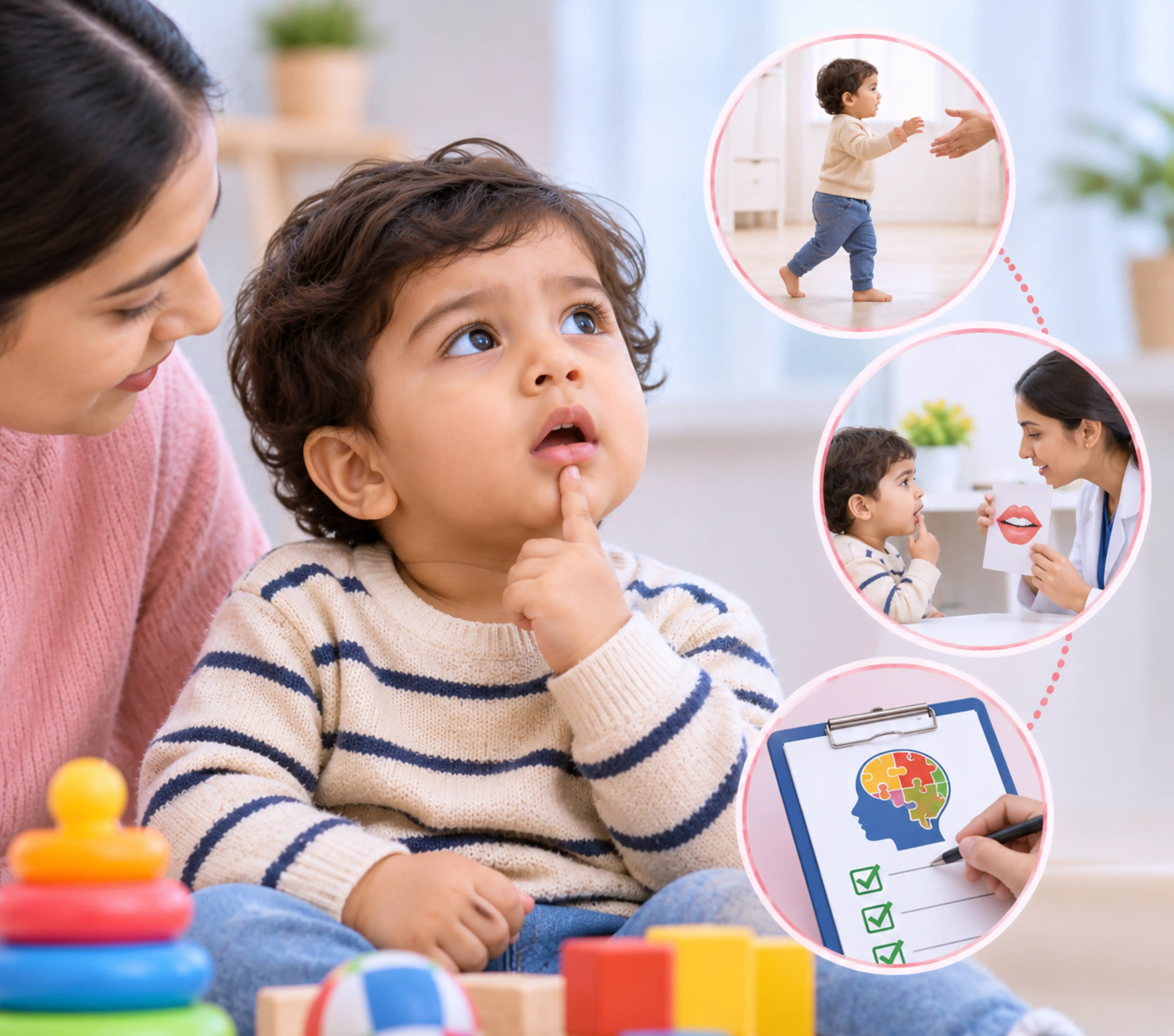
Why Some Toddlers Talk Late
- Hearing problems, including fluid behind the eardrum after repeated ear infections
- Familial late talking, where a parent or sibling also talked late
- Language disorder or oral-motor difficulties that affect how sounds are planned and produced
- Autism spectrum disorder or global developmental delay
- Premature birth
- Limited back-and-forth interaction, including long stretches of passive screen time
Growing up in a multilingual home does not cause speech delay. Many Indian families worry about this, so it is worth knowing.
How Is Speech Delay Assessed?
A good assessment looks at the whole child, not only their words. It usually includes:
- A developmental history covering pregnancy, birth, milestones, and family history
- A hearing test, which every late-talking child should have, because newborn screening does not rule out hearing loss that develops later
- A speech-language evaluation of understanding, expression, play and communication
- A developmental screening or standardised assessment
- Autism screening when there are concerns, such as the M-CHAT-R/F between 16 and 30 months
- A neurological examination if there are other delays or lost skills
Treatment: Speech Therapy and Home Support
Treatment depends on the cause, and often more than one approach is used:
- Speech-language therapy, with individual sessions and coaching so parents can continue the work at home
- Treatment of hearing problems, from care for ear infections to hearing aids when needed
- Occupational or behavioural therapy when the child has other developmental needs
Parents can help at home too:
- Talk through daily routines and name what you are doing together
- Read picture books and sing rhymes every day
- Offer choices (“milk or water?”) and wait a few seconds for a response
- Expand on what your child says (“car” becomes “red car”)
- Limit screen time. WHO advises against screens for children under two and suggests no more than an hour a day for ages two to four
- Avoid pressuring your child to “say it”, as this can make them withdraw
When to See a Doctor
Do not wait and see if any of the warning signs above apply to your child, or if you simply have a worry that won’t go away. An assessment does no harm, and early support works best because a young brain responds quickly to therapy. Frustration, frequent tantrums, and not responding to their name are also good reasons to book an assessment.
Where Can I Get a Speech Delay Assessment for My Child in Jaipur?
Neo Clinic’s Saarthak Child Development Center provides early intervention and therapy for developmental delays, disabilities, and behavioural challenges. The team includes a speech therapist, an occupational therapist, and an ABA therapist, with pediatric neurology support.
When you compare options for the best child development center in Jaipur, check whether hearing, speech, development, and behaviour can all be assessed in one place. A pediatric speech therapist in Jaipur should also work with you as a partner and give you practical activities for home, not just sessions in the clinic.
Supporting Language Growth Every Day
- Have conversations during meals, baths, and play
- Read together daily
- Play simple turn-taking games
- Treat ear infections promptly
- Keep screens for short periods and watch together
- Ask about developmental screening at routine vaccine visits
Progress in therapy is gradual, and steady practice at home matters more than the number of sessions.
Conclusion
Late talking worries parents because the answer is not always clear. The reassuring part is that an early assessment is safe, simple and often calming, and that early therapy gives children the best start. If your toddler’s speech is behind, or you are simply unsure, speech therapy for toddlers in Jaipur can begin with a single assessment. The Saarthak Child Development Center team at Neo Clinic can assess your child and guide the next steps.